

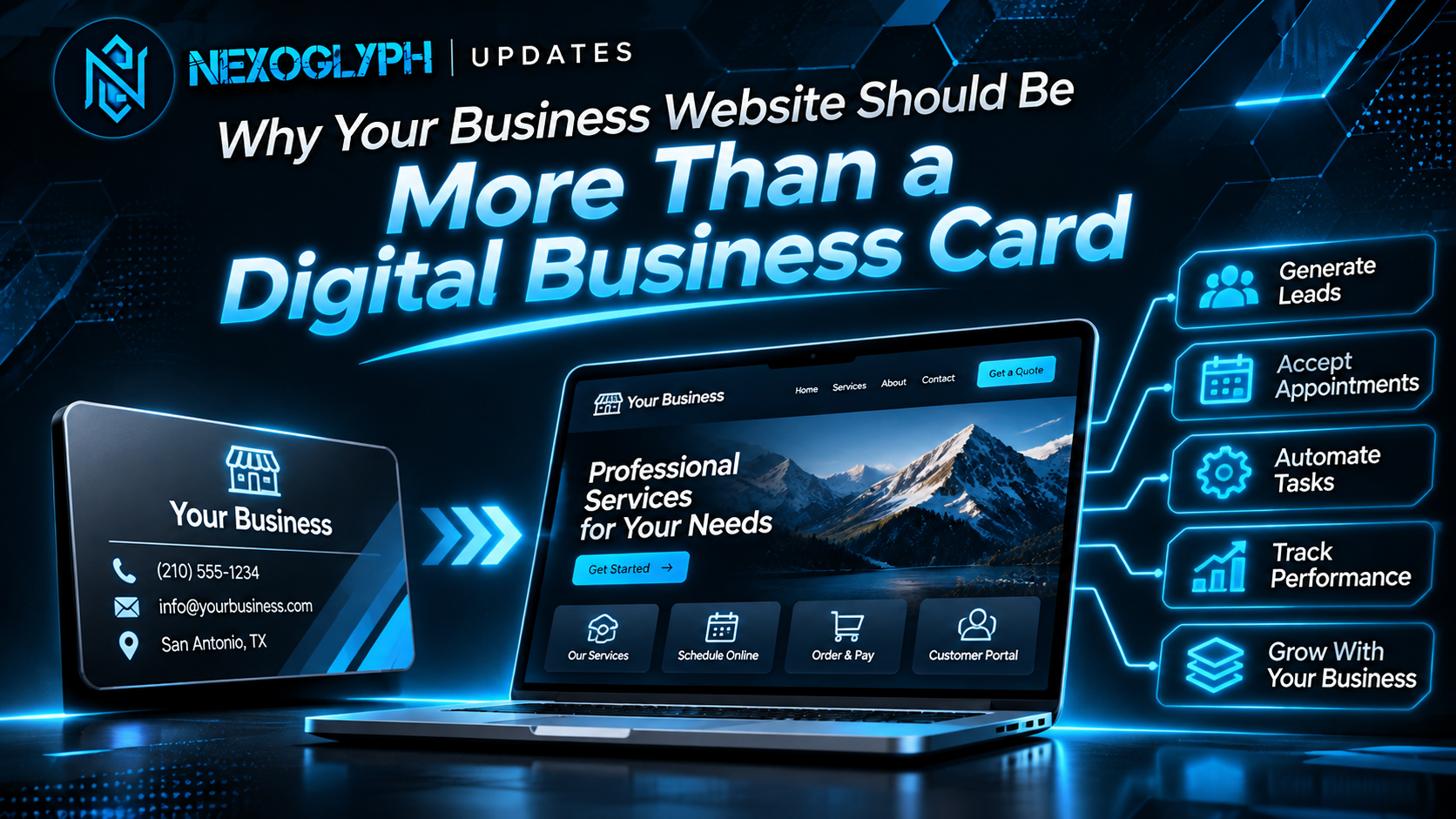
For many businesses, having a website is considered a basic requirement. It’s a place to display a company name, list services, provide contact information, and establish an online presence.
But is that really enough?
A website that only provides your business name, phone number, and a brief description of your services isn’t much different from a traditional business card. While it serves a purpose, it leaves a significant amount of potential untapped.
Your website shouldn’t just tell people your business exists. It should help your business operate, connect with customers, and grow.
Modern websites can do far more than display information. From generating leads and automating customer interactions to supporting online transactions and integrating with business software, a well-designed website can become an active part of your daily operations.
Let’s explore why your business website should be more than a digital business card—and how you can make it work harder for your business.
1. Your Website Should Have a Purpose Beyond Existing Online
Every business website should answer one important question:
What do you want visitors to do when they arrive?
For a local contractor, the goal might be encouraging customers to request estimates. A restaurant may want visitors to view its menu, place an order, or make a reservation. A professional consultant might want potential clients to schedule an introductory meeting.
These are all different objectives, and each requires a slightly different website strategy.
A website designed around a specific purpose can guide visitors toward meaningful actions rather than leaving them to figure out what to do next.
For example, instead of simply displaying a list of services, a website could include:
- A prominent button to request a quote
- An appointment scheduling system
- A form tailored to a customer’s specific needs
- A product catalog or online ordering system
- A customer support or inquiry portal
- A searchable collection of helpful resources
The goal isn’t to overwhelm visitors with features. It’s to make it easier for them to accomplish what they came to your website to do.
2. Turn Website Visitors Into Potential Customers
One of the biggest missed opportunities for small business websites is failing to provide a clear path from browsing to contacting the business.
Imagine two plumbing companies.
The first has a basic website containing its name, phone number, and a list of services.
The second provides detailed service pages, customer testimonials, service-area information, and a simple form where homeowners can describe their plumbing problem and request an appointment.
Both businesses have an online presence, but the second website gives potential customers more information and a more convenient way to take the next step.
This is where lead generation becomes important.
A lead is a potential customer who expresses interest in your products or services. Your website can help capture that interest through thoughtfully designed contact forms, quote requests, appointment scheduling, and other interactions.
Effective lead-generation features include:
- Clear Calls to Action: Buttons and links that explain the next step, such as “Request an Estimate” or “Schedule a Consultation.”
- Simple Contact Forms: Forms that collect relevant information without asking unnecessary questions.
- Service-Specific Pages: Dedicated pages explaining individual services and helping customers find exactly what they need.
- Trust Signals: Customer reviews, project examples, certifications, and other information that supports credibility.
- Mobile-Friendly Contact Options: Click-to-call phone numbers and easy-to-use forms for smartphone visitors.
These features don’t guarantee new customers, but they can make it easier for interested visitors to become genuine business inquiries.
3. Build Trust Before the First Conversation
Before contacting a business, many customers want reassurance that they’re making the right choice.
Your website offers an opportunity to answer their questions and demonstrate professionalism before they ever speak with you.
A strong business website can communicate:
Who You Are
Tell visitors about your company, its background, and what makes your approach different.
What You Offer
Explain your products or services clearly, including the problems they solve.
Who You Serve
Help visitors understand whether your business is the right fit for their needs.
What You’ve Accomplished
Showcase completed projects, examples of previous work, customer testimonials, or relevant experience.
How Customers Can Reach You
Make contact information and the next steps easy to find.
For example, a web development company might display examples of websites it has created, describe its development process, and explain its hosting services.
A home improvement contractor might showcase before-and-after photos, explain available services, and provide project estimates.
The important consideration is relevance. Customers should be able to quickly understand what your business does and why they should consider working with you.
4. Make Your Website a Customer Service Tool
Customer service doesn’t always require a phone call or email.
A well-organized website can answer common questions and help customers find information independently.
Consider how often businesses receive questions such as:
- What are your operating hours?
- Which areas do you serve?
- How much do your services cost?
- Do you offer appointments?
- What payment methods do you accept?
- How can I check the status of my request?
Providing these answers directly on your website can reduce repetitive inquiries and improve the customer experience.
Depending on your business, useful features might include a frequently asked questions section, online booking, order tracking, a customer portal, or a knowledge base.
For example, a business that regularly handles service requests could use a website form to collect the customer’s name, contact information, service location, and description of the problem.
That information could then be delivered to the appropriate employee or integrated into an existing management system.
Instead of simply advertising your services, your website becomes part of how those services are delivered.
5. Automate Repetitive Business Tasks
Automation is one of the most valuable capabilities a modern website can provide.
Many businesses spend time repeating the same administrative tasks, such as collecting customer information, sending appointment confirmations, updating records, or notifying employees about new requests.
Some of these processes can be automated through website functionality and software integrations.
For example:
Appointment Scheduling
Customers book available appointments online, reducing the need to coordinate every appointment by phone.
Customer Notifications
A form submission automatically generates a confirmation email or alerts the appropriate staff member.
Lead Management
New customer inquiries can be organized and forwarded to a customer relationship management (CRM) system.
Online Payments
Customers can pay invoices or purchase services directly through an integrated payment provider.
Data Synchronization
Information entered through a website can be transferred to other business applications through compatible integrations or APIs.
Not every business needs advanced automation. However, identifying even one repetitive process that could be simplified may create meaningful operational benefits.
The goal is to reduce unnecessary manual work while keeping the customer experience straightforward.
6. Connect Your Website to the Software You Already Use
Many businesses rely on multiple software platforms to manage their daily operations.
These might include accounting systems, scheduling applications, customer databases, inventory management software, and email marketing platforms.
Without integration, employees may need to manually transfer information from one system to another.
Modern websites can often communicate with external applications through Application Programming Interfaces (APIs).
An API allows compatible software systems to exchange information and perform defined operations.
For example, a business website could connect to an appointment scheduling system, send customer inquiries to a CRM platform, or retrieve product information from an inventory database.
These integrations can help reduce duplicate data entry, improve consistency, and streamline certain workflows.
Some integrations are available through existing plugins or commercial services. Others may require custom development.
This is one area where professional web development can offer capabilities beyond a basic informational website.
7. Help Customers Discover Your Business Through Search Engines
A website also provides an opportunity for potential customers to discover your business through search engines.
However, simply publishing a homepage doesn’t guarantee that customers will find you.
Search engine optimization (SEO) involves improving website content and technical structure to help search engines understand your pages and their relevance to user searches.
For a small business, this may include:
- Creating dedicated pages for individual services
- Publishing helpful articles answering customer questions
- Using descriptive page titles and headings
- Optimizing images and page loading performance
- Ensuring the website functions properly on mobile devices
- Providing accurate business and service-area information
- Establishing clear internal navigation between related pages
For example, a landscaping company might publish articles about seasonal lawn care, common drainage problems, or preparing a yard for summer.
These articles provide useful information to readers while creating additional opportunities for the business to appear in relevant searches.
This is one reason an actively maintained website can be more useful than a collection of static pages.
It becomes a resource that continues providing value over time.
8. Use Website Analytics to Make Better Decisions
A website can also help businesses better understand how visitors interact with their online presence.
Analytics tools can provide information about website traffic, popular pages, visitor devices, and actions taken on the website.
Depending on the tools used and how they’re configured, businesses may be able to answer questions such as:
- Which services receive the most attention?
- Where do website visitors come from?
- Which pages generate the most inquiries?
- Are visitors primarily using smartphones or computers?
- Which content attracts the most engagement?
- Where do visitors stop before completing an important action?
This information can help guide future decisions.
For example, if a particular service page receives substantial traffic but very few inquiries, the business might review its content, contact options, or call-to-action placement.
If mobile users frequently encounter difficulties completing forms, the business can investigate whether improvements are needed.
Analytics should be implemented with appropriate privacy considerations and applicable legal requirements in mind.
Used responsibly, website data can provide valuable insight into customer behavior and website effectiveness.
9. Your Website Should Be Able to Grow With Your Business
A website that meets your needs today may not meet them several years from now.
A startup might initially need only a homepage, an about page, and a contact form.
As the business grows, it may want to introduce online purchasing, customer accounts, appointment scheduling, or specialized business functionality.
Planning for this possibility can reduce unnecessary complications later.
A scalable website doesn’t necessarily mean building every advanced feature immediately.
Instead, it means selecting an appropriate platform, organizing the website effectively, and considering how additional functionality could be introduced in the future.
For example, a WordPress website may begin as a simple informational site and later expand through suitable plugins or custom development.
Other businesses might eventually need a dedicated web application designed around their operational requirements.
The right technology should support your business’s development rather than become an obstacle to it.
10. Not Every Website Needs to Be Complicated
With so many possibilities, it’s easy to assume that every business needs a complex website packed with advanced features.
That’s not the case.
A small local business may only need a handful of well-designed pages and a reliable contact form.
An online retailer may require a full e-commerce system, while a professional services company might benefit from scheduling and customer management integrations.
The most effective website isn’t necessarily the one with the most features.
It’s the one that accomplishes its purpose efficiently.
Adding functionality simply because it’s available can introduce unnecessary costs, maintenance requirements, and technical complexity.
Instead, businesses should identify their priorities and invest in the features that provide meaningful value.
How NexoGlyph Approaches Business Websites
At NexoGlyph LLC, we view websites as more than collections of pages.
They’re digital tools that can help businesses connect with customers, communicate their services, and improve how they operate.
Our services include professional web development, managed hosting, and custom technology solutions designed around individual business requirements.
For some clients, the right solution may be a straightforward website that establishes credibility and makes it easier for customers to get in touch.
For others, it may involve custom functionality, software integrations, automation, or a more specialized web application.
Rather than treating every project the same way, our goal is to understand what the business needs and identify a practical solution.
We believe technology should be useful, accessible, and built with a clear purpose.
Final Thoughts
Having a website is important, but having a website that actively supports your business can be far more valuable.
A digital business card tells people who you are.
A well-planned business website can help people discover you, understand your services, contact your team, complete transactions, and interact with your business more efficiently.
It can support customer service, simplify repetitive processes, provide useful information, and grow alongside your organization.
That doesn’t mean every business needs an expensive or complicated website.
It means your website should have a purpose beyond simply existing online.
Whether you’re launching your first website or considering improvements to an existing one, start by asking a simple question:
Is your website just providing information, or is it helping your business move forward?
Ready to Make Your Website Work Harder?
NexoGlyph helps businesses build professional websites, manage their hosting, and explore custom technology solutions that support their goals.
Discover how NexoGlyph can help you turn your website into a more valuable business tool.
Related Posts
What Is Managed Web Hosting, and Why Does Your Business Need It?
Managed web hosting simplifies website ownership by handling essential responsibilities such as server administration, updates, security, backups, performance optimization, and technical support. This article explains how managed hosting differs from
Read Full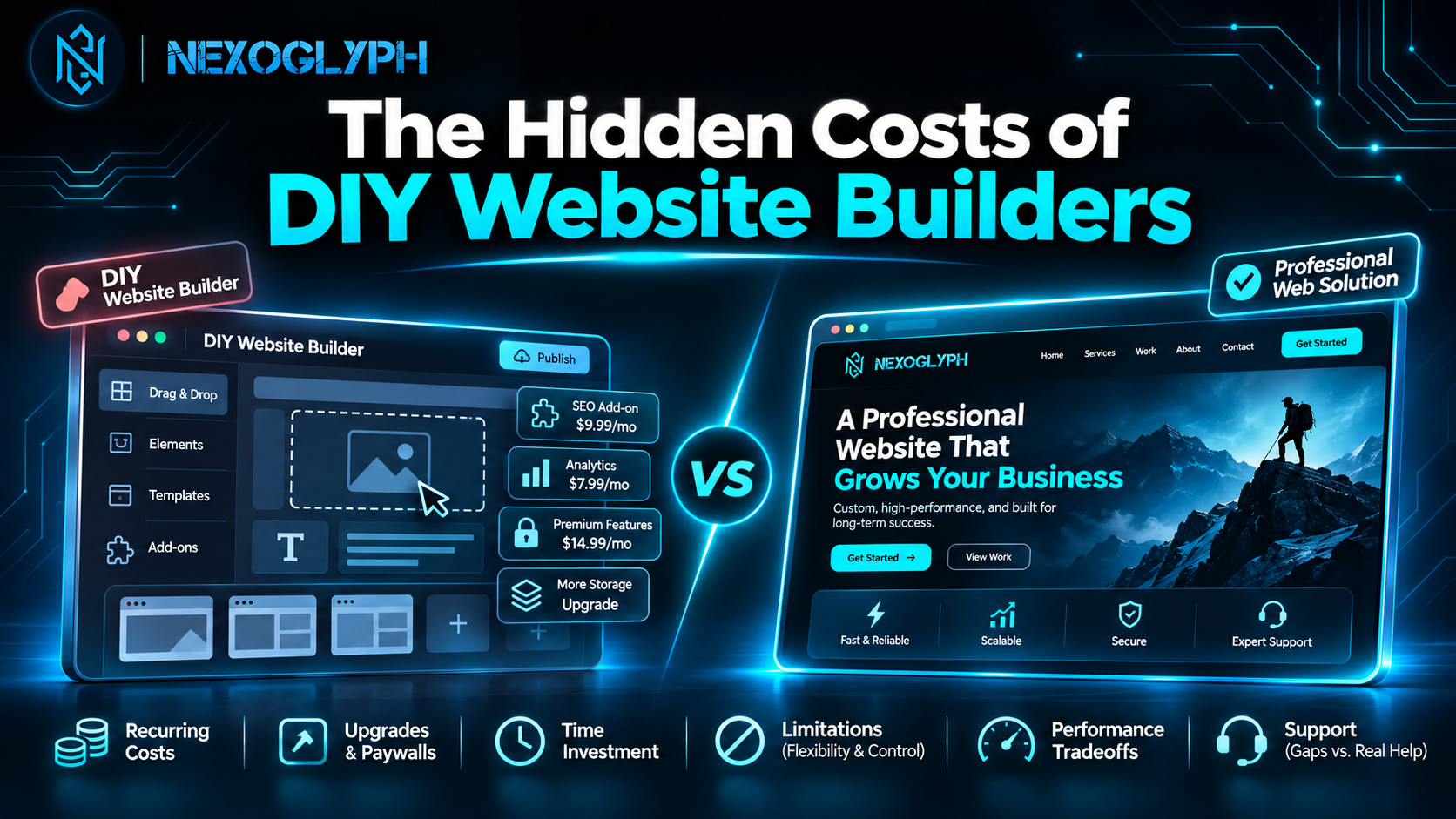
The Hidden Costs of DIY Website Builders: What Small Businesses Should Know
DIY website builders offer an accessible, affordable way to establish an online presence, but their true costs can include premium features, time, maintenance, limited customization, SEO challenges, performance constraints, and
Read Full