


A professional website is one of the most valuable digital assets a business can have. It helps customers discover your services, learn about your brand, and connect with your business. However, launching a website is only the beginning. Keeping it online, secure, updated, and performing efficiently requires ongoing attention.
That’s where managed web hosting comes in.
For many business owners, managing servers, software updates, backups, and technical issues can become overwhelming. Managed web hosting helps simplify these responsibilities, allowing businesses to focus on their customers and daily operations rather than the technology behind their websites.
In this article, we’ll explain what managed web hosting is, how it differs from traditional hosting, and why it may be a worthwhile investment for your business.
What Is Web Hosting?
Before understanding managed hosting, it’s important to understand web hosting itself.
Every website needs a place to store its files, images, databases, and other resources. A web hosting provider supplies the server infrastructure that makes these resources accessible over the internet.
When someone enters your website address into their browser, their device connects to the server hosting your website and retrieves the information needed to display it.
Without web hosting, your website wouldn’t be accessible to visitors online.
However, not all hosting services provide the same level of management or technical assistance.
What Is Managed Web Hosting?
Managed web hosting is a hosting service in which the provider handles specified technical and administrative responsibilities associated with maintaining a website or its hosting environment.
Instead of leaving the business owner to manage everything independently, a managed hosting provider may assist with:
- Server Management: Maintaining and configuring the hosting environment.
- Website Updates: Keeping supported website software, themes, and plugins current.
- Security Maintenance: Applying appropriate security measures and addressing vulnerabilities.
- Website Backups: Creating and maintaining backups to support recovery when something goes wrong.
- Performance Optimization: Identifying opportunities to improve loading speeds and server performance.
- Technical Support: Helping troubleshoot hosting-related problems and website issues.
- Domain and SSL Management: Assisting with domain configurations and secure HTTPS connections.
The specific services included vary between providers and hosting plans.
The primary advantage is simplicity. Businesses can benefit from professional hosting infrastructure without necessarily having to develop the technical expertise required to manage it themselves.
Managed Hosting vs. Traditional Web Hosting
Traditional hosting services often provide the infrastructure needed to operate a website while leaving many maintenance responsibilities to the customer.
Managed hosting adds a layer of technical assistance and ongoing administration.
Here’s how the two approaches generally compare:
| Feature | Traditional Hosting | Managed Hosting |
|---|---|---|
| Server Infrastructure | Provided | Provided |
| Server Administration | Provider or customer, depending on plan | Provider handles defined responsibilities |
| Website Software Updates | Often customer-managed | May be included |
| Backup Management | Varies by plan | Often included |
| Security Maintenance | Shared responsibilities | Additional assistance may be provided |
| Troubleshooting | Primarily hosting-related support | Potentially broader technical assistance |
| Technical Knowledge Required | Can be moderate to advanced | Generally lower |
Neither option is automatically better for every situation.
Businesses with dedicated IT teams or experienced developers may prefer the flexibility of managing their hosting environment independently.
However, businesses without internal technical resources may find managed hosting considerably more convenient.
5 Reasons Your Business Should Consider Managed Web Hosting
1. Spend Less Time Managing Technology
Running a business already involves managing customers, employees, finances, scheduling, and daily operations.
Website maintenance shouldn’t become another major responsibility.
Managed hosting reduces the amount of time business owners need to spend dealing with technical administration. Instead of troubleshooting server configurations or researching software updates, they can rely on their hosting provider for the services covered by their plan.
This can be particularly valuable for small businesses that don’t have dedicated technical personnel.
2. Improve Website Security
Website security is essential for protecting business operations and maintaining customer confidence.
Websites can be exposed to threats such as malicious software, unauthorized access attempts, outdated plugins, and exploitable software vulnerabilities.
Managed hosting providers may help reduce these risks through:
- Software updates and security patches
- Appropriate server configuration
- SSL certificate management
- Malware monitoring or scanning
- Access controls and account security practices
- Backup and recovery procedures
While no hosting service can guarantee complete protection from cyberattacks, proactive maintenance can significantly reduce avoidable security risks.
3. Maintain Reliable Website Performance
Visitors expect websites to load quickly and function properly.
Slow loading times can frustrate potential customers, reduce engagement, and make a business appear less professional.
Website performance depends on multiple factors, including server resources, website configuration, image sizes, application code, and network conditions.
A managed hosting provider can help identify and address performance problems within the scope of its service.
This may involve reviewing resource usage, adjusting hosting configurations, troubleshooting errors, or recommending website optimizations.
A reliable hosting environment provides the foundation for a better user experience.
4. Protect Your Website With Backups
Imagine losing your website because of a failed update, accidental deletion, corrupted database, or security incident.
Without a usable backup, restoring your website could be difficult, expensive, or even impossible.
Backups provide a way to recover website data when unexpected problems occur.
Managed hosting plans frequently include scheduled backups, although their frequency, retention periods, and restoration services vary.
When selecting a hosting provider, businesses should ask how often backups occur, how long they are retained, and whether restoration assistance is included.
Having a backup is important. Knowing that the backup can be successfully restored is equally important.
5. Access Technical Expertise When You Need It
Technical problems don’t always happen at convenient times.
A website might experience a configuration error, an expired certificate, a database connection issue, or a software compatibility problem.
For business owners unfamiliar with web servers and hosting technology, identifying the cause can be challenging.
Managed hosting gives businesses access to technical assistance without necessarily hiring an in-house administrator.
The level of assistance depends on the provider, but having someone familiar with your hosting environment can make troubleshooting more manageable.
Does Every Business Need Managed Hosting?
Not necessarily.
Managed web hosting is particularly useful for businesses that depend on their websites but don’t want to handle technical administration themselves.
Examples include:
Local Service Providers: Plumbers, electricians, contractors, and other service businesses that rely on their websites to generate customer inquiries.
Restaurants and Retailers: Businesses that publish menus, operating hours, product information, or online ordering functionality.
Professional Services: Consultants, accountants, and other professionals who need a reliable online presence.
Startups and Entrepreneurs: Growing businesses that would rather direct their time and resources toward development and customer acquisition.
Organizations and Nonprofits: Groups that need accessible websites without the complexity of maintaining their own hosting infrastructure.
For these businesses, managed hosting can provide a practical balance between convenience, technical assistance, and affordability.
What Should You Look for in a Managed Hosting Provider?
Not every managed hosting plan includes the same services.
Before choosing a provider, consider the following questions:
- What does the monthly fee include? Determine whether website updates, security maintenance, backups, and technical support are included or billed separately.
- How are backups handled? Ask about backup frequency, storage, retention, and restoration procedures.
- What happens when something goes wrong? Understand the provider’s support availability and responsibilities.
- Can the hosting grow with your business? Consider whether additional storage, bandwidth, or server resources can be accommodated.
- Who controls your website and domain? Make sure you understand ownership, account access, and what happens if you decide to change providers.
The best hosting solution isn’t necessarily the most expensive one. It’s the one that provides the resources and services your business actually needs.
Managed Web Hosting With NexoGlyph
At NexoGlyph LLC, we believe business technology should be practical, accessible, and straightforward.
Our approach combines professional web development with managed hosting and technology solutions, helping businesses establish and maintain their online presence without unnecessary complexity.
By offering website development, hosting, and related technical services, NexoGlyph aims to reduce the challenges of coordinating multiple technology providers.
Whether you’re launching your first business website, upgrading an existing online presence, or exploring custom functionality, our goal is to help you find a solution that fits your needs.
We understand that every business is different, which is why we emphasize practical solutions rather than unnecessary features or complicated technical arrangements.
Final Thoughts
Your website represents your business around the clock. It provides information, connects with customers, and often serves as the first impression someone has of your brand.
Keeping that website accessible, maintained, and secure deserves attention.
Managed web hosting helps businesses reduce technical responsibilities while benefiting from ongoing hosting administration and support.
For businesses without dedicated IT resources, it can be a valuable way to simplify website operations and concentrate on what matters most: serving customers and growing the business.
Interested in simplifying your website hosting?
Explore NexoGlyph’s web development and managed hosting solutions to learn how we can support your business’s online presence.
Related Posts

Why Your Business Website Should Be More Than a Digital Business Card
A business website should do more than display contact information. This guide explains how purposeful design can generate leads, build trust, support customer service, automate repetitive tasks, integrate with business
Read Full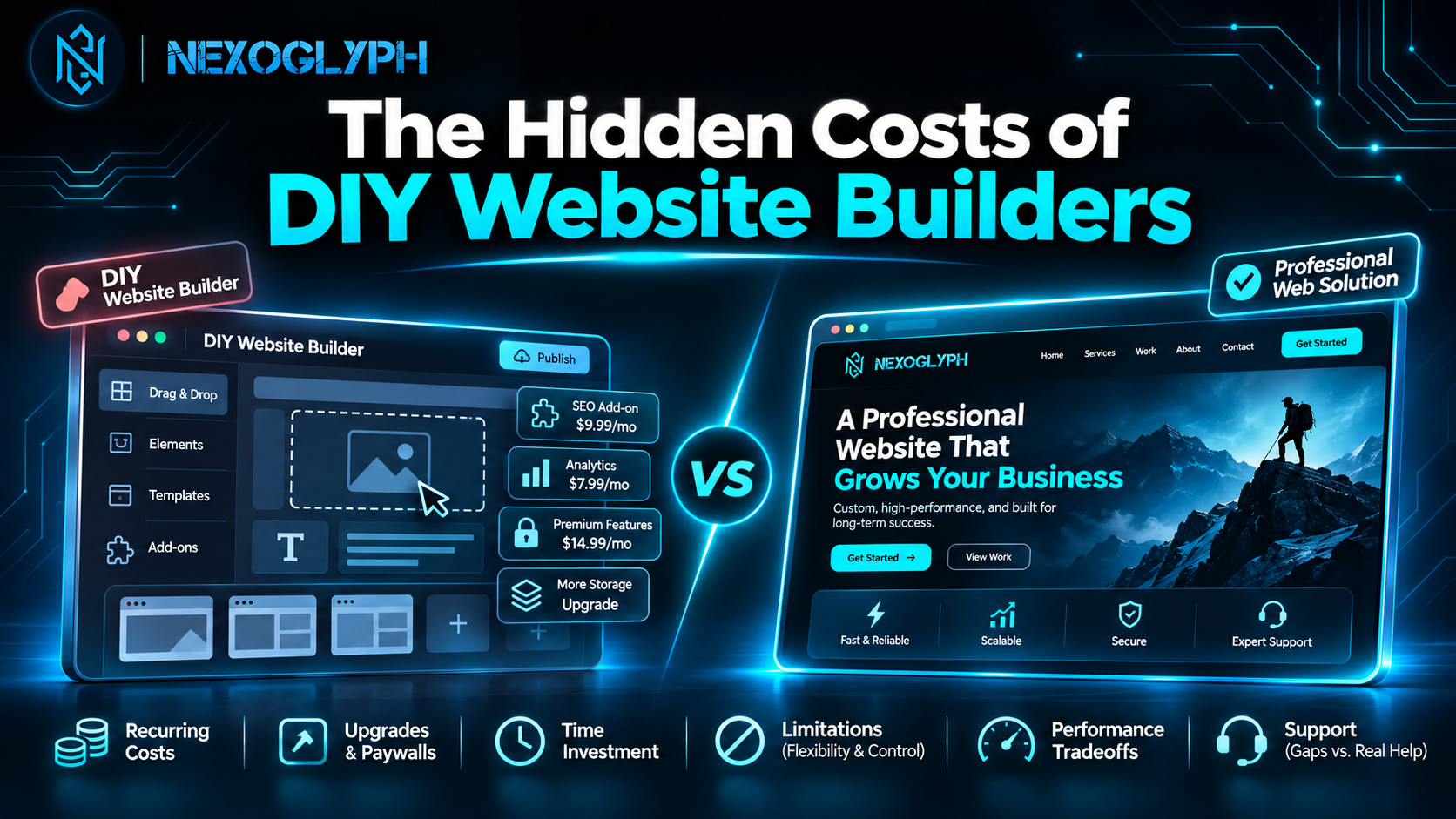
The Hidden Costs of DIY Website Builders: What Small Businesses Should Know
DIY website builders offer an accessible, affordable way to establish an online presence, but their true costs can include premium features, time, maintenance, limited customization, SEO challenges, performance constraints, and
Read Full